


Budget 2025: Supporting working families in kids’ busing
Working families with school-going children face rising cost-of-living pressures, with school transport costs emerging as a major concern in recent years.
In this commentary, Michael Lien, Chairman of Leap201, proposes Bus4Kids, a scheme modelled after the Assurance Package (COL Special Payment) framework. Families can receive $200 to $400 annually based on household income, covering up to two months of school transport fees.
He also calls for a broader rethink of government education assistance schemes, which currently target only the lowest-income households. To keep pace with rising costs and support more working families with school-going children, he advocates expanding and standardizing income criteria to a broader range of $1,800 to $2,300.
To keep pace with rising costs and support more working families with school-going children, he advocates expanding and standardizing income criteria to a broader range of $1,800 to $2,300.
Rising cost of education-related expenses
In recent years, Singapore has made commendable strides in creating a family-friendly environment, from enhanced parental leave to housing support1 . The Forward Singapore engagement exercise underscored that starting and raising families with young children is a key national priority2 .
Yet, amid these efforts, a growing concern is hitting working families with school-going children hard: the rising cost of education-related expenses, such as school transport fees.
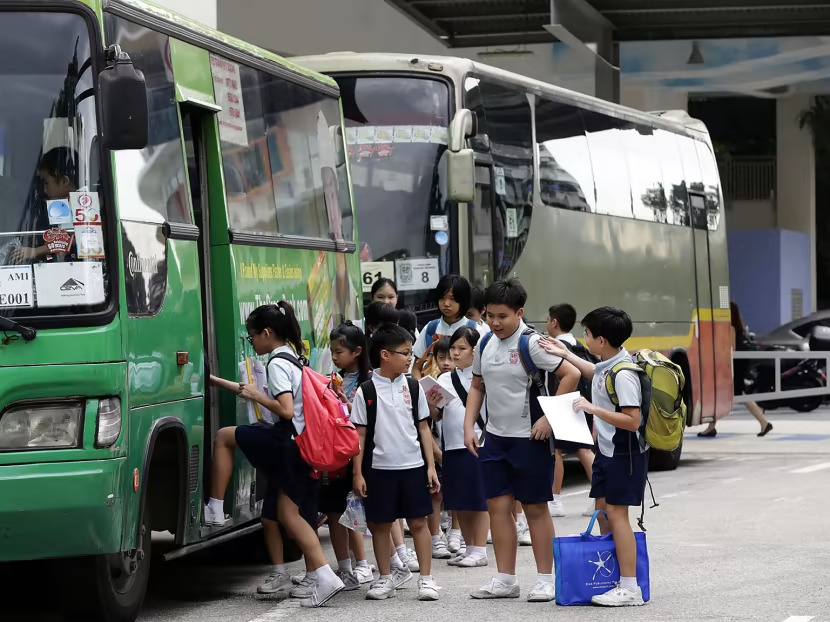
The financial strain of rising school bus fares
The rise in school bus fees in recent years has grabbed attention in news recently. In fact, one of these reports quoted that an operator has announced a 66% increase in school bus fares for 20253. This is equivalent to a $65 increase, approximately the amount spent for school meals in an entire month.
For many parents, school bus services are not a luxury but a necessity. Not many families own a car, and for those with primary-school children, public transport for daily school commutes may be inconvenient, especially for working parents with long commutes themselves.
And unlike school fees, which are heavily subsidised, school transport remains an overlooked cost-of-living item despite some efforts by the government to increase such support4.
Today, a two-way school bus ride could easily cost between $300 and $400 per month per child, a steep expense for working families, especially those who earn too much to qualify for existing government aid but still struggle with rising costs.
The case for greater government support in education expenses
The government has rightly recognised cost-of-living concerns. Prime Minister Lawrence Wong has acknowledged these pressures5, and signalled that Budget 2025 will address families’ anxieties over rising costs, such as introducing new support measures for large families6.
However, we believe a more targeted intervention is needed for a broader group of working families beyond the lowest-income — one that directly addresses the impact of rising education-related expenses.
1. A Bus4Kids Scheme: Making School Transport Affordable
A possible solution to support working families with cost-of-living pressures is a new Bus4Kids scheme, which could provide tiered cash payouts to families with primary school children.
Drawing inspiration from the Assurance Package (Cost-of-Living Special Payment)7 framework, it is possible to design a scheme according to three per capita income bands. The lowest income band could be set at the 10th decile level or about $1,200 based on the latest household income data8, while the highest income band could be set between the 40th and 50th decile level.
Based on the principle of progressiveness, working families with school-going children at the lowest band could receive $400 per child, while families at the highest band could receive $200 per child, offering much-needed relief for working parents.
To ensure funds are used for their intended purpose, an alternative model could involve crediting payments to the Child Development Account (CDA), allowing accredited school bus operators to claim directly.
2. A Fundamental Rethink of Existing Education Financial Support Schemes
2.1 Expanding the scope of education related support to more families
While current government schemes provide critical support for the lowest-income families, they do not adequately address the challenges faced by a growing segment of lower-to-middle-income households. It’s time for a fundamental rethink of how financial assistance schemes can better support a broader range of families, especially when it comes to education-related costs.
2.2 Existing Government and Community Support for Education Expenses
Today, there are a few government financial assistance schemes that provide relief for different types of education expenses. These include: a) the Ministry of Education’s Financial Assistance Scheme (MOE FAS) that covers school and miscellaneous fees such as stationery and uniform, food and transport; b) The Ministry of Social and Family Development’s Student Care Fee Assistance Scheme (SCFA) which subsidies student care fees such that those from the lowest income families pay as little as five dollars a month; c) The InfoComm Media Development Authority’s Digital Access Programme provides subsidies for laptops and other essential devices to support students from lower-income families.
d) These are complemented by community initiatives such as the Straits Times School Pocket Money Fund and more localised support by the Community Development Councils and social service agencies.
This array of education support programs each have their own eligibility criteria, but the common feature is they tend to target the lowest-income households. For example, the MOE FAS’s per capita monthly income criterion is $750, which is within the lowest decile by per capita monthly income of $1,151.
2.3 Expanding and Standardising Income Criteria across Schemes
As living costs continue to rise, it’s crucial to broaden the coverage of financial assistance for education expenses to support working families with school-going children. We propose raising and standardising the per capita income eligibility of these schemes to a broader range of between $1,8009 to $2,300, potentially covering households up to the 30th income percentile.
Similar to the first proposal above, the principle of progressiveness can be applied such that a smaller subsidy can be given to families at a relatively higher income level.
We noted such adjustments is underway in some community initiatives, where Self-Help Groups have begun raising income criteria10 for their tuition support schemes. Extending this approach nationwide would bring much added relief to lower-to-middle-income families, who often feel squeezed by cost-of-living pressures but don’t qualify for existing government aid.
Managing today’s costs, investing in our future: A Bold Call to Action
Singapore celebrates its 60th year of independence this year. As we reflect on how far we have come, we must also make bold investments in the future generations. Education has long been a pillar of social mobility in Singapore, and ensuring that every child has equal opportunities—regardless of family income—must be a national priority.
We have seen major investments in preschool education in recent years, ensuring that children get a strong start in life. But as they progress into primary school, more can be done to manage education costs for working families amidst rising living costs. We believe that financial constraints should not limit a child’s potential.
The Bus4Kids scheme and a more fundamental rethink of existing government education financial assistance schemes are not just about easing cost-of-living pressures — they are about reinforcing Singapore’s commitment to fairness and opportunity. These proposals seek to empower working families for a better future, key themes as we refresh our social compact.
People are our most precious resource, and investing in our children is the best investment we can make. By taking decisive action today, we can build a fairer and stronger Singapore for generations to come.