


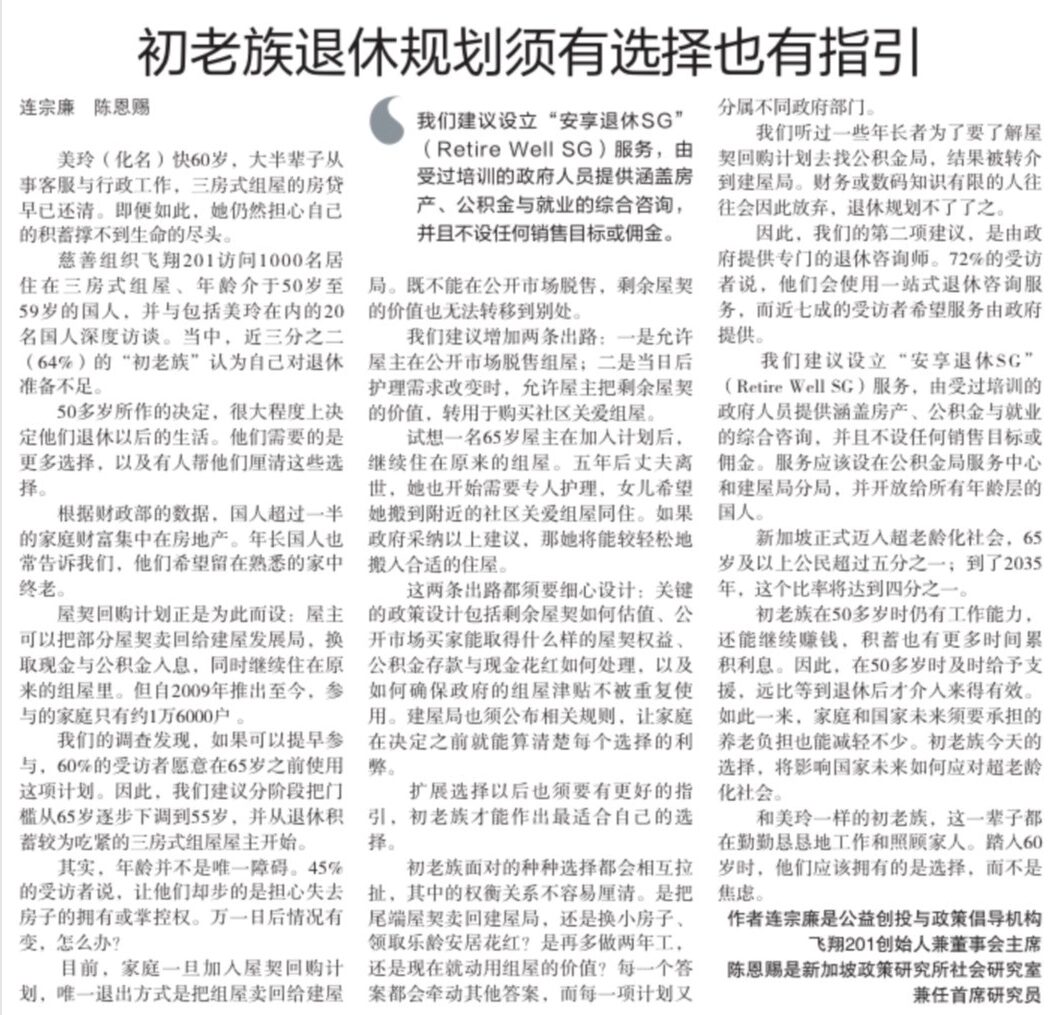
An opinion piece on SG Home4Life (SGH4L) was published in Lianhe Zaobao on Oct 6, 2026.
The piece, by Leap201 Chairman Michael Lien and Dr Tan Ern Ser of the Institute of Policy Studies, put forth SGH4L policy recommendations such as Retire Well SG, a one-stop conflict-free retirement advisory, and more flexible exit options from the Lease Buyback Scheme.
Translation of opinion piece:
Young seniors need both choices and guidance to plan for retirement
Michael Lien and Tan Ern Ser
Mei Ling (not her real name) is nearly 60. She has spent most of her working life in customer service and administration, and the mortgage on her three-room HDB flat was paid off long ago. Even so, she worries that her savings will not last the rest of her life.
Leap201, a charity, surveyed 1,000 Singaporeans aged 50 to 59 who live in three-room HDB flats, and interviewed 20 of them in depth, including Mei Ling. Nearly two-thirds (64 per cent) of these “young seniors” feel under-prepared for retirement.
The decisions people make in their fifties largely decide how they will live after retirement. What they need are more choices, and someone to help them make sense of those choices.
Ministry of Finance data shows that more than half of Singapore household wealth is held in property. Older Singaporeans also often tell us they want to grow old in the home they know.
The Lease Buyback Scheme was designed for exactly this. Owners can sell part of their flat’s lease back to the Housing Board in exchange for cash and CPF income, while continuing to live in the same flat. But since the scheme was introduced in 2009, only about 16,000 households have joined it.
Our survey found that 60 per cent of respondents would be willing to use the scheme before 65 if they could join earlier. We therefore propose lowering the eligibility age in phases, from 65 to 55, starting with owners of three-room flats, whose retirement savings tend to be tighter.
Age is not the only barrier. Forty-five per cent of respondents said what held them back was the fear of losing ownership or control of their home. What if their circumstances change later?
Today, once a household joins the Lease Buyback Scheme, the only way out is to sell the flat back to HDB. The flat cannot be sold on the open market, and the value of the remaining lease cannot be moved elsewhere.
We propose two more ways out. First, allow owners to sell their flat on the open market. Second, when their care needs change, allow owners to use the value of their remaining lease to buy a Community Care Apartment.
Picture a 65-year-old owner who joins the scheme and stays on in her flat. Five years later, her husband passes away and she starts to need dedicated care. Her daughter wants her to move into a Community Care Apartment nearby. If the Government adopts our proposals, she will be able to move into suitable housing more easily.
Both exit routes need careful design. The key policy questions include how the remaining lease is valued, what lease rights an open-market buyer acquires, how the CPF top-up and cash bonus are treated, and how to make sure government housing subsidies are not used twice. HDB should also publish the relevant rules, so families can weigh the pros and cons of each option before they decide.
Wider choice must also come with better guidance, so that young seniors can make the choices that suit them best.
The choices young seniors face pull against one another, and the trade-offs are hard to untangle. Should they sell the tail end of their lease to HDB, or right-size to a smaller flat and receive the Silver Housing Bonus? Should they work two more years, or tap the value of their flat now? Each answer affects the others, and each scheme sits with a different government agency.
We have heard of older Singaporeans who went to the CPF Board to find out about the Lease Buyback Scheme, only to be referred to HDB. People with limited financial or digital literacy often give up at that point, and their retirement planning goes no further.
Our second proposal, then, is dedicated retirement advisers provided by the Government. Seventy-two per cent of respondents said they would use a one-stop retirement advisory service, and nearly seven in 10 want the service to be provided by the Government.
We propose a Retire Well SG service, in which trained government officers give integrated advice covering housing, CPF and employment, with no sales targets or commissions. The service should be located at CPF Service Centres and HDB branches, and be open to Singaporeans of all ages.
Singapore has officially become a super-aged society, with more than one in five citizens aged 65 and above. By 2035, this will reach one in four.
In their fifties, young seniors can still work and earn, and their savings have more time to grow. Support given in time, in their fifties, is far more effective than stepping in only after they retire. It would also substantially ease the burden of old-age support that families and the nation must carry in future. The choices young seniors make today will shape how Singapore copes as a super-aged society.
Young seniors like Mei Ling have spent their lives working hard and caring for their families. As they reach 60, they should have choices, not anxiety.
Michael Lien is founder and chairman of Leap201, a venture philanthropy and policy advocacy organisation. Dr Tan Ern Ser is Adjunct Principal Research Fellow at the Institute of Policy Studies.